Tuesday, 29 January 2013

'Newbridge' curtains


This post is about a particular style of curtain valance, which originated in the early part of the 19th century and which I have really grown to appreciate and wish was used more often.
 
The historical example I have come to know well is in the Drawing room of Newbridge House, Ireland. Since I started work with Alec Cobbe in 1994, I have had the pleasure of numerous visits, as it was built for his direct ancestor Charles Cobbe (1686 - 1765), Archbishop of Dublin.
The house was built in the years around 1750, after plans supplied by no-one less than James Gibbs and it is this original house that can still today be seen across the lawn, virtually unchanged. It is a restrained Palladian structure with 6 windows across the facade; it is three rooms wide and two rooms deep.

The second generation Cobbes needed more space and in 1764 a new wing was added to the back of the house containing bedrooms above and a very grand drawing room below, which also served as gallery for the growing collection of paintings. One side of the room has a large three-window bay in the middle with single windows on either side. Above these there are heavy gilded poles with enormous wooden rings and from these hang the valances.
It is this arrangement that I have come to like so much. It is actually a really simple way to make a grand statement. There are no swags, tails or cornices and no complicated separate pieces pretending to be one drapery. It is simply a pleated skirt hanging straight down from a decorative pole. Behind this the curtains themselves hang from an invisible track. Unlike 'swag and tail' pelmets with gilded cornices etc both the curtains and valances can easily be removed for cleaning and dusting.
    
 Not only the curtains, but the whole room is an incredible survival, virtually untouched since the 1830s. The flock wallpaper may even date from the 18th century, although a Greek style border was added to it later. The accounts have a substantial sums to a carver gilder, ‘Mr Kearney’for curtain ‘rods’ and an upholstering establishment, ‘Messrs Mack and Gibton’ for ‘curtains’ in 1828, which probably refer to these poles and curtains. The fitted carpet was definitely supplied in 1823 and amazingly is still there.
 
This is one of the side windows. Curtain geeks like me will want to know that the valance is not 'gathered' but kind of pleated, forming ca 15cm (6") wide folds, and there are small rosettes marking the points where the rings are attached.
A gold coloured braid goes round all 3 sides of the curtains, not just the leading edge and the bottom, as is usual today. 
The curtains are remarkably narrow. The track runs along the top of the window architrave and is 160 cm (63") long, but each curtain is 120 cm (47") wide, making for a fullness of only 1.5 (as opposed to the 2.5 - 3 that is often used nowadays). Perhaps not wide, they were certainly long; in fact no less that 30 cm (12") 'overlong'. This extra length was recommended at the time against drafts. When opened, the curtains were hooked up on brass stays, creating great billowing swags.
 
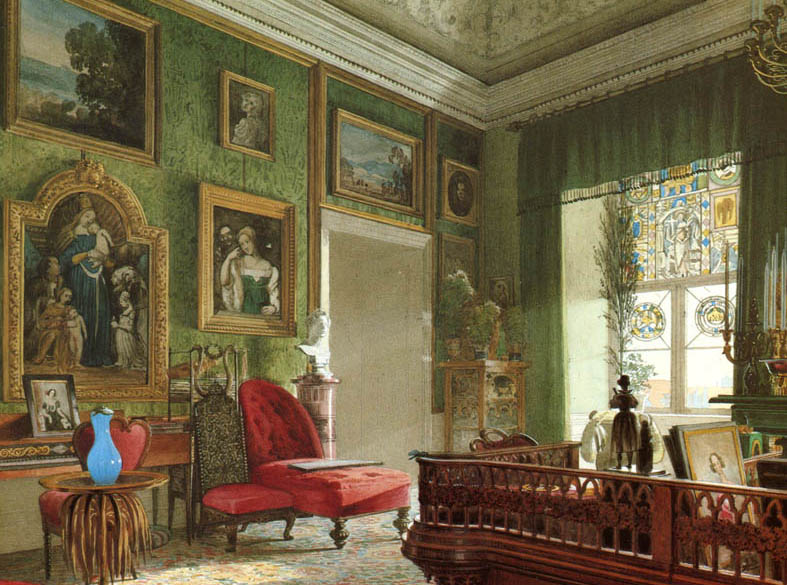
In 1840, an amateur drawing of the room was done, probably by the young Frances Power Cobbe  (who became an interesting person in her own right), which depicts not only the curtains, but also many pieces of furniture that are still present in the room today. Interestingly it shows a summer arrangement with four curtains removed, or perhaps pairs of curtains were drawn to one side . 
 
This particular curtain/valance type seems to have been a kind of house style for Newbridge. Above the Drawing Room there was a bedroom with the same bay window and a photograph of ca 1905 shows this room with a continuous skirt, which came down to chair rail height in between the windows. The Dining Room has this type of valance as well, but those came from another house in Co. Dublin, Kenure Park (built in the 18th century and enlarged in the first half of the 19th) and were purchased by the Cobbes when the contents were sold up in 1964. Finally, the Library has a bay window too, with one big continuous pole above it. Originally there were two sets of curtains for this room: chintz for summer and heavy rep for winter. About ten years ago I made new chintz curtains and a valance for the room, in the same style
 
 
This style of curtain valance - a skirt hanging straight down from rings on a decorative pole - I haven't found anywhere before the second quarter of the 19th century. It was in that period that books began to be published that not only supplied professional upholsterers but also interested amateurs and house holders with the latest trends and fashions in interior design. One such book, by John Claudius Loudon, contained this plate in 1833, which included a section of the pole/board/track construction, explaining how it worked.  
 
Loudon recommended that this design "may be considered for a cottage finished in the Grecian style , including under that term the Italian manner". What that last bit means I don't know, but it is clear that he thought this style suitable for a room considerably more modest than the Newbridge Drawing Room. He also stated that "the pole to which the drapery is attached would look remarkably well if stained of a mahogany colour, or in a gothic cottage to resemble oak".  Perhaps this 'cottage' use, explains why so few valances of this type seem to have survived and how seldom they have been depicted.
Here is one from 1835, decorated with rope on the valance and braid around the curtains:
 
 
Valances like this are surprisingly rare in historic interior views; I have only found a handful; amongst them is this country library, with points that come down to about two thirds of the total height.
 
 
 George Pyne painted a number of student rooms in Oxford colleges around 1860.
They are charming and one day I should write a piece about them here.
 Some of them have what I now call the 'Newbridge' type valance:    
 
 
In Germany there was a strong tradition for windows draped in the Empire style throughout the first half of the 19th century, often entirely made of muslin, but around 1850 in the Royal Palace in Berlin there were several rooms with simple, straight valances hung from poles. One of these is just visible in the left margin of my blog - and here is another, in one of those beautiful watercolours by Eduard Gaertner. The fabric in the valance seems to hang almost flat, which is a surprisingly un-grand effect for what must have been an important royal palace. 
 
 
From the 1870s onwards there was a change in the fashion for curtains and valances, partly caused by writings by authors such as Charles Eastlake, who despised the complicated constructions of fixed swags and tails that were impossible to clean and were deemed ugly and unhealthy dust traps. There were also new theories about fresh air etc and general good health.
Eastlake recommended simple iron rods with curtains that hang straight down, just touching the
floor. Tiebacks were not allowed. The only possible elaboration was a 'lambrequin' ; a rectangular piece of fabric attached to a wooden board above the rod, with the sole function of draft exclusion. His book became extremely influential and the new theories permeated the highest echelons of society. Although rooms could become ever more covered in pattern and crammed with furniture and objects, and although the textiles became ever more richly woven and embroidered, the actual shape of curtains became very simple indeed.

So there was a simplifcation in style but at the same time an elaboration in materials, and this can be clearly observed in the pages of  'Artistic Houses', which was published in 1883 and recorded the latest and most sumptuous interiors of the time in places like New York, Boston and Philadelphia etc. It is a fascinating insight of how the richest people in the world lived at one time, and a must for enthusiasts for Edith Wharton, who was 22 when the book was published and knew some of the houses.
Amongst the 203 photographs only one shows swagged curtains in the style that Eastlake railed against (Mrs Cornelia's M. Stewart's bedroom, but her vast house really belongs to an earlier age).
All other curtains are made from richly embroidered and decorated materials, often with horizontal bands of decoration, and although they look undoubtedly expensive, their construction couldn't be more simple. There is only one exception; the Dining Room of the Clara Jessup Moore House in Philadelphia. Although the window curtains are as simple as Eastlake would have them, over a doorway we find our old friend the valance from a pole:   
 
 
In the Netherlands there is a beautifully preserved house of the same period, built by a wealthy Bisdom van Vliet heiress and her husband in ca 1875. She was widowed 6 years later, was childless and left the house and everything in it to a foundation after her death in 1923. It is one of the most complete survivals of late 19th century interiors, as it was only ever lived in by one person. 
The interiors show the mid-19th century neo 'tous les Louis' style with swagged and tailed curtain valances everywhere. Everywhere except in the 'front' and 'back'  rooms downstairs.
Here the curtains must have been redone about 10 to 20 years later with flat valances hung from brass poles. In the front room these are of red velvet with panels of brocade in the 'artistic' style of the 1880s : 
 
In the back room they are embroidered with flowers in Art Nouveau style, which I would say date from a few years later again. Eastlake would have approved of the fabric and the flat valance, but hanging it from a pole would for him defy the purpose of draft excluder: 
 
Something not dissimilar, called 'Window Lambrequin' was offered in a Boston catalogue of 1883 : 
 
I will end with a couple of windows that  were dressed in this 'Newbridge' style more recently,  returning first to the original ones, as Alec and I had them copied for English Heritage about ten years ago. When they asked us to redecorate the four main rooms of Kenwood House, London, for various reasons the 1828 of the Newbridge curtains date was exactly right for the dining room, which doubled as a picture gallery, and we installed exact copies of them.
 
 I also found this American dining room online, decorated (I believe) by Jed Johnson.
 
This is how it can look in a sleek modern room, although to my mind the poles could have been more interesting : 
 
 
And finally the curtains I wake up with every day myself, done in a Braquenie fabric which is now sadly discontinued, on a wall of Farrow and Ball 'Dead Salmon'. There is 50 cm (20") of wall between the top of the window and the ceiling cornice, so the valance simply fills that whole space and takes no light away from the room. Putting the pole right up gives the room a great sense of height as well. I think this is a type of curtain valance that is very historical,
very attractive, very simple to make and surprisingly unusual.


Illustrations:
 
1. Newbridge Front - from Country Life Magazine, Photographer Paul Barker.
2. Newbridge Drawing Room - from www.newbridgehouseandfarm.com.
3. Newbridge Side window - my photo.
4. Drawing by FP Cobbe - supplied by Alec Cobbe.
5. Newbridge Library - from www.newbridgehouseandfarm.com  (detail).
6. Curtain design by John Claudius Loudon, from Encyclopedia of Cottage, Farm, and Villa Architecture and Furniture, 1833. In : Capricious Fancy Draping and Curtaining the Historic Interior 1800 - 1930, Gail Caskey Winkler, Philadelphia, 2013.
7. Curtain design by Thomas King, from Valances and Draperies, consisting of New Designs for Fashionable Upholstery, 1835. In : Capricious Fancy Draping and Curtaining the Historic Interior 1800 - 1930, Gail Caskey Winkler, Philadelphia, 2013.
8. Interior of a Library. In: Inside Out, Charles Plante Fine Arts. Also in: Nineteenth-Century Decoration, the Art of the Interior, Charlotte Gere, 1989.
9. Interior of an Oxford College, George Pyne, ca 1856. From Sotheby's sale catalogue (Safra Collection).
10. Room in the Berlin Stadtschloss, by Eduard Gaertner. In: Authentic Decor, The Domestic Interior 1620 - 1920, Peter Thornton, 1984.
11. Dining Room of the Clara Jessup Moore House in Philadelphia. In: The Opulent Interiors of the Gilded Age, all 203 Photographs from 'Artistic Houses', Dover Publications, 1987.
12 & 13. Interiors of Museum Bisdom van Vliet - my photos.
14. Window Lambrequin, from sale catalogue R.H. White & Co. spring and summer 1883. In : Capricious Fancy Draping and Curtaining the Historic Interior 1800 - 1930, Gail Caskey Winkler, Philadelphia, 2013.
15. Kenwood House Dining Room, in: Country Life Magazine
16. Dining Room, Jed Johnson, from Internet.
17. Sitting Room, from Internet
18. Bedroom, my photo.


Friday, 11 January 2013

FAVOURITES - nr 1

The ETRUSCAN ROOM at POTSDAM

This is going to be a series of my favourite historic room views, and the first one has to be taken from the famous book by Mario Praz, which in English is called:  An Illustrated History of Interior Decoration from Pompeii to Art Nouveau (1964, available in paperback)This is the work that pioneered the study of historic room images and it is still a good place to start (although, frankly, I find the text a bit overblown).  
The room is one of those fantastical, slightly mad and totally 'designed' rooms which only happen in the kind of Royal palace where there is a lot of money to spend, but not a lot to do all day. It is the kind of room that you walked through, admired the design of, and revelled in the fashionable strangeness. 
The artist was Friedrich Wilhelm Klose and he painted this around 1840. 


The theme is etruscan, a style that appeared in the early 19th century as part of the renewed interest in all things classical, although the decorative scheme is based on vases from Greece.
The room was created in the 'Stadtschloss', or Palace, of Potsdam, near Berlin, which was the winter residence of the Kings of Prussia. Originally built in the 17th century, it was enlarged in several stages and Friedrich Wilhelm III had interiors, including this one, redesigned in 1802- 04 by Friedrich Gottlieb Schadow.  
The room was on the corner of the building that is closest to us in this view and had three windows on the south front and one looking west.

Although it was the Etruscan Room, there were no actual etruscan objects in it, but there were seven Greek vases on display. These may not even have been originals, but I guess they were. The rest of the room is pure decorative entertainment, an ornamental fantasy inspired by the vases, that celebrated their beauty and strangeness; it does not try to be an ancient room. This was long before the excavations of Troy etc, so there was very little known about etruscan or ancient greek culture, and the smooth black pots with their terracotta decorations must have seemed truly other wordly to the average courtier at the time.
So we find black panels with pale figures all around the room, including on the ceiling. There are black palmettes in the freeze, which in plaster would become a very common motif in 19th century interiors.


The dado area is rather plain and must have looked very unusual, as instead of the classical skirting board, the wall is flat, with a graphically strong greek key ornament, inlaid in the wood. The architect seems to have been experimenting here and with the traditional chairrail he dispensed all together.  


I love this mad sofa, and actually all the soft furnishings in the room are wonderfully inventive. Somebody had great fun designing these black embroideries on the pink, which looks like it could be silk satin. The design and wooden front is in the style of Schinkel and it looks like a very smart piece of furniture.


The curtains had similar black ornamentation, fringes and even black tassels.  I love the drapery on the window on the left. It is slighlty mad and assymmetrical and must have been balanced by the third window on that wall, the one we can't see. The middle window, which was opposite the sofa, probably had the same arrangement as the one that we can see, in the middle of the picture.
  

There don't seem to be draw curtains, but the tails are unusally long. In fact they reach the floor, next to the pots that are standing on their own bespoke little podium in front of the mirror. 

I'm intrigued by that round table in the corner, which doesn't look designed to go in this room. It suggests some use of the room that developed in later years. Perhaps tea was had in this room and the table was left empty to receive a cloth and a tray. The chairs and the open window look inviting and the 'double aspect' must have given interesting views and very nice light. I can imagine the whole room glowing in the low evening sun.

It is the only the chandelier that I find a bit disappointing. It looks like any other palatial chandelier really, and perhaps somebody could have had a go at designing something more fitting for this weird and wonderful room.


Amazingly, although the room was designed and decorated at the beginning of the 19th century, photographs exist of it from around the 1930s and they show the room virtually unchanged. They also show the incredible detail and accuracy of Klose's painting. The detailing of the sofa is slightly different but I suppose the cover needed to be remade at some point in the almost 100 years between these images. Otherwise the chairs in the window and the curtains look totally as they did in 1840.


I suppose this perfect survival shows how much of a 'set piece' this room was. It was a perfect and complete design and the furniture that was designed for it never moved to another room because it would have look out of place anywhere else.
And here is a view of the other side of the room, that shows how there were three windows on the long wall and two sets of pots on the floor between them. The curtains look as if they have exactly the border that is shown in the painting, but they, too, were remade at some point. 


Given the beauty and quality of the original design and the near survival of the whole scheme,  including the vases and furniture, for more than a century, it is incredibly sad that the room was totally destroyed in the war. The exterior of the Potsdam palace is being recreated at the moment (it will house a modern office building), but this wonderful room is one of the many cultural casualties of war.


Illustrations:

The Etruscan Room, Potsdam, by Friedrich Wilhelm Klose
View of the Palace at Potsdam  (detail), by Johann Friedrich Meyer (1728-1789)

Photograph Max Baur, between 1928 and 1944  (German Federal Archives)


Sunday, 30 December 2012

'Antique Drapery'


Having started my blog with the 1845 Christmas view of Windsor castle, which showed luxurious blue silk hangings, I will share my thoughts about these 'antique draperies', as they were called in the original accounts. These took the form of a large single curtain, draped around a room, attached and looped from cloak pins (with some kind of gilded rosettes), at the top of the wall, just underneath the cornice. The curtain usually falls all the way down to the floor so that no flat wall is seen anywhere and the hooks are usually 2 or 3 feet apart.  
'Antique drapery' is not the same as a 'Tent' rooms, which are obviouly designed to suggest standing in a real tent, so here not only the walls but also the ceiling is covered in fabric, and the mood is usually less formal.


The room in the 1845 Christmas view was part of a suite decorated in 1828 for lady Conyngham, who was King George IV's mistress at the time and it was her daughter's room. There was one other room with this kind of continous drapery in the castle and this was actually the King's own bedroom, equally hung with blue and gold silk, although the drapery didn't quite go around the entire room and didn't drape over the doors. The long thin panel behind the stool was filled in with mirror glass, and perhaps the proportions of the space in this ancient building prescribed the decorative solutions.


King George IV had a similar scheme in the Throne Room of his London palace, Carlton House, again done in royal blue. Here, the drapery covers the wall behind the throne, which looks more like a sofa,  and also frames the fireplace mirrors and the doors.


So far all these draperies are Royal blue, but Carlton House also had a Crimson Drawing Room where everything was, well, crimson.


The extravagance of Carlton House knew absolutely no bounds. The Crimson Drawing Room had a kind of double valance that run round the entire ceiling cornice with deep gold fringeing, and thick bunched up columns of silk hung not only as dress curtains at the windows, but also on either side of the doors and even beside the fireplace. It is not strictly speaking either 'antique drapery' nor a tent room, but amazing it certainly is. It is one of those historic images which, if you try to imagine a room actually decked out with that amount of fabric today, it would still be both absolutely astonishing and completely over the top. The chandeliers alone were considered among the finest in Europe and the huge pieces of mirror glass between the windows must have cost a fortune at the time.
Beside the crimson satin damask and the endless gold almost everywhere else, there is an interesting black theme running through the room as well, from the black marble fireplace, the black and gold doors through to various sculptural groups on the tables, the candelabras and the rather surprising black braid on the chairs. Amongst all this opulence the carpet was wisely kept a bit plain, although being velvet, it again was the height of luxury. Here is a detail of what must be one of the most sumptious rooms ever created, showing this sea of crimson with the interesting black accents and also how incredibly detailed these interior views could be.


The fashion for draping whole rooms in loose fabric may have started with the 'Turkish' style, which in the 1770s joined the ranks of  the 'exotic' interior styles like Chinese, Indian, Etruscan etc.
Marie Antoinette had a Turkish boudoir at Fontainebleau in 1777 and Turkish tents (permanent structures made out of metal or plaster, imitating fabric) appeared in various influential gardens like Painshill in England and Haga in Sweden.
In the interior there appeared rooms with loose draped fabric and soft 'divans' (a Turkish word), a kind of banquette that had no visible wooden structure and lots of loose cushions. This design of around 1800 may have been for another of King George IV's bedrooms, this time at his Chinese/Indian palace in Brighton.


Although there are 18th century examples, the taste for 'tent' rooms as well as for 'antique drapery' really took off  in the Napoleonic period at the beginning of the 19th century. Firstly, there was the 'Egyptian campaign' led by Napoleon Bonaparte (as French General) between 1798 and 1802, which caused a huge fashion for all sorts of 'campaign' furniture, tent rooms, and lots of loose fabric hung over spears, arrows etc. Secondly, after he became Emperor in 1804, Napoleon took the artistic language of the Roman Empire as his prime decorative inspiration, both for architecture and for interior design. These two influences, the battle/campaign style and architecture of ancient Rome, changed the 'draped look' for ever, giving it a much more masculine character. From the cushioned atmoshpere of an exotic 'harem', it became a manly and rather cold military style, albeit equally theatrical and romantic. Large scale draperies began to suggest power and wealth and were thought suitable for grand public rooms instead of merely for private boudoirs and bedrooms.

Nowehere is this  elegant and extravagant but also rather cold style more obvious than in one of the most famous bedrooms ever created: Empress Josephine's, at Malmaison near Paris. It was designed by Charles Percier and Pierre Fontaine, who did so much to develop the Empire style for Napoleon and I can just imagine how exciting and fun it must have been. They designed a highly ornate, circular tent, seemingly on some glorious emperial battlefield, that is open to the sky. It's a wonderful conceit with, for once, a painted sky that truly makes sense. Genius, although they never saw it themselves. The room was finished later in the century by Empress Eugenie while the room today is a 20th century restoration of the original design.


But I digress. Although Empress Josephine's bedroom had draperies, it is most definitely a tent room. The origins of 'Antique Drapery', that is loose curtains hung from a series of pegs, were found on Greek and Roman sculpture reliefs like this one:


There was, of course, nothing new about copying Greek and Roman architecture, but still, when a Madame Recamier had her bedroom designed with antique drapery in 1802, she showed herself as ahead of her time with something that was totally new. This room was published amongst images of 'The most beautiful houses in Paris', and seen by a lot of people, including the English architect Robert Smirke who made this watercolour view of it. The bed also survives today, we can be fairly certain that, unlike a lot of Percier and Fontaine designs, the room really looked like this.


DRAPERY AND MIRRORS

This is a little side line. One typical element in both 'tent' and 'draped' rooms of the Empire period, is the theatrical use of mirrors, which may have started with this room for Mme Recamier. The above images seems to indicate mirror glass behind the bed, inside the curtains, suggesting some kind of opening in the wall of fabric, and this became a favourite device in these rooms. I guess that mirror glass began to be available in ever larger single pieces, so draperies could be pulled back to reveal a seemingly larger space. Before, they would have needed window bars etc, which would not have given the same theatrical effect.

Napoleon's own bedroom at Malmaison also shows this combination of continous drapery, parting to reveal a large mirror, which didn't even need a decorative frame as it would have been invisible. This is a redecoration from the 1970s, when the palace opened to the public, based on designs from the period.
The English architect Thomas Hope, who knew Percier and Fontaine well and who pioneered the Empire style in England, also created a draped room, using mirrors to great effect. The continuous drapery, apparently of satin in 'the fiery hue that fingers the clouds just before sunrise', is parted in various places revealing large sheet of mirror glass, causing a pattern of drapery and reflections around the room, which at night must have been extraordinary.
He created this room and others in his house around 1800, opened it all to visitors and published images in 1807.


Another beautiful example of combining drapery with mirror glass, is this tent room in Paris (1811), made for Queen Hortense, who had married Napoleon's brother and had been Queen of Holland for a few years. Another blue and gold room, it shows the use of mirror glass particularly well, as wherever the curtains part, the room is reflected and hardly any solid wall is seen anywhere.


But I digress again. Back to 'Antique Drapery'; this time as it appeared in other countries, following Napoleon's military as well as dynastic successes, as here in 1811, in the Royal Palace in Naples, where he had created a Kingdom for his sister and her husband.


And in Germany it was the architect Karl Friedrich Schinkel who championed the Empire style. This room was in one of the Royal palaces in Berlin that he worked on, in 1829. The drapery was of white muslin with embroidered borders, hung from what looks like rossetes made of  bunched up fabric.


So now we're back at the year when George IV had the blue and gold 'antique drapery' created at Windsor Castle; both in Lady Conyngham's daughter's room as well as in his own bedroom, as seen at the top of this post. There are two much later views of the King's bedroom, from 1868, showing the room with two single beds and arranged as something like a shrine to Prince Albert, much mourned by Queen Victoria since 1861. I suppose this room remained in use as the royal bedroom, but that the Queen stopped using it after Albert's death.
The remarkable thing is that by 1868, the blue silk hangings were still in the room, even though they were by then 40 years old. This may be a testimony to both the quality of the original fabrics and of the political stability of England, as so much of continental furnishings of the same period must have been destroyed in all the various European revolutions. And anyway, all that muslin can't have had a very long life either.


It is not surprising that most of the rooms here were created in Royal or even Imperial palaces, where matters of cost and upkeep mattered perhaps less than the splendour that gorgeous silk draperies could offer. The initial cost of the fabrics (not to mention the hand made borders and fringes) and the practical difficulty in keeping it all clean and dust free must have been enormous.

DRAPERY WALLPAPERS

So for those with not quite a royal but still considerable budget, there was wallpaper that imitated fabric hangings. I'm not entirely sure when this started, but I found this French example of 1825, which shows how the paper offered the designer the freedom to design swags, tails and ornamentation much more elaborate than what would have been possible with real fabric.


And then to my joy I saw this very same paper, on a red ground this time, in this view of ca 1829, which shows it beautifully, although it is also clear that it rather dominates the room.


The fashion for actual continuous drapery came to an end around this time, but the taste for white muslin curtains dressed in the Empire style over gilded rosettes, spears etc would continue, particularly on the European continent, for several decades. I suppose for England they were just too summery and thin.

THE 20th CENTURY

Tent rooms continued to be popular throughout the 19th century and are still being created today, but I'm not so sure about 'antique drapery'. Milicent Rogers' sitting room in 1935 had loose hangings of crimson silk, very similar to the Napoleonic draperies, except for the mirror which was simply placed on the fireplace in front of the fabric.
  

I guess that the most likely form that decorators would fabric drape a room today is shown in this image of Babe Paley's sitting room, which was decorated by Billy Baldwin in printed cotton around 1950. The fabric is not looped from pins, but it does run continuously round the room and parts for the fireplace and the windows.


Both these last rooms were created in New York, for famous and immensely rich ladies, which I guess shows that this extravagant way to furnish a room continues to attract the Queens of society, just like it did in Empress Josephine's time. 


ILLUSTRATIONS:

1. Windsor Castle Interior, Joseph Nash, 1845.
In: For The King's Pleasure, Hugh Roberts, 2001, p.270 
2.  Design for the King's bedroom , Office of Morel and Seddon, c.1826. In: Roberts, p.151
3. The Throne Room at Carlton House, Charles Wilde, c.1816 (detail). in: Roberts, p.158
4 & 5. Carlton House Drawing Room, Charles Wilde , c.1817 (detail).
in: The Royal Interiors of Regency England, David Watkin, 1984.
6. Tented alcove, designed by Crace & Co, c.1800.
in:  English Decoration in the 18th Century, John  Fowler, John  Cornforth,  p.146
in: House Proud,  Gail Davidson, Floramae McCarron-Cates, Charlotte Gere, p.19
7. Bedroom Empress Josephine, Chateau de Malmaison. in: Great Palaces,  Sachaverell Sitwell
8. Greek bas relief.  In: An illustrated History of Interior Decoration,  Mario Praz
9. Mme Recamier's bedchambre, Robert Smirke, 1802. In: Authentic Decor, Peter Thornton, p.188
10. Napoleon's  bedroom, Chateau de Malmaison
In: Architecture Interieure et Decoration en France, Jean Feray, p.328
11. The Flaxman Room, from Hope's 'Household Furniture and Interior Decoration', 1807.
In: English Interiors 1790 - 1848, John Cornforth, p.109
12. Queen Hortense's tented boudoir, Auguste Garneray, 1811. In: Thornton, p.195
13 Room in the Royal Palace, Naples, Montagny, 1811. In: Praz
14.  Princess Augusta's 'Muslin Closet', Berlin 1829. In: Thornton, p.248
15.  Windsor Castle, room 202, William Corden, 1868. In: Roberts, p.161
16.  Wallpaper, France, 1825. In : The  Papered Wall, Hoskins, Wisse
17.  Drawing Room in Nice, ca.1830, unknown artist. In: Thornton, op.256
18 - Sitting Room for Milicent Rogers by McMillen, ca 1930
In: Twentieth Century Decoration, Simon Calloway, p.177
19 -Sitting Room for  Babe Paley by Billy Baldwin, ca 1950
photo from internet


Saturday, 8 December 2012

MERRY CHRISTMAS 2012


Why not start this blog about the Weird and Wonderful World of Historic Interiors with this festive and seasonal display of royal christmas presents underneath a table top tree at Windsor castle in 1845.
The room is on the first floor on the south front, the castle's most iconic side, looking out over the famous long walk, and its walls are completely covered in loose blue draperies. At first, I assumed these to be some kind of occasional treatment, in order to set off the tree and the tables laden with presents, but the room was actually decorated like that almost 20 years earlier, at the time when King George IV was rebuilding so much of the castle, covering most of it with silks, velvet and gold in the process. 
The room was part of a small suite reserved for the daughter of Lady Conyngham, the King's mistress. The original accounts have been preserved and speak of  'a continued antique drapery, counterlined with wadding, ornamented with very rich blue and white silk fringe...the whole suspended from ... gilt rosettes'. I guess 'counterlined' is what we now call interlined, so they were proper curtains that hung around the entire room, only parting for and draping over the doors and the fireplace mirror. The same material was used for the window curtains, so at night a couple of candles must have rendered the effect of being completely cushioned in draped shiny blue silk truly magical. 
The extravagance of George IV's interiors never fails to amaze. For this and the next room, which were really of quite modest size and grandeur, and were presumably never seen by anyone important, over a thousand yards of silk was delivered in 1828.
I have no idea what the room looks like today, but to have this view and be able to read the bills for all the furnishing work next to it, is rare and wonderful.
Finally the image is interesting for its depiction of the tree. The custom of Christmas trees spread slowly through European noble families in the early nineteenth century and arrived in the British Royal family with Queen Charlotte, who was born a German princess. Queen Victoria had a tree in her room every Christmas as a young princess, but it was after she had married the German Prince Albert that the tradition spread outside court circles. At the time of this watercolour they had been married for 5 years and one can imagine them strolling through the Grand Corridor on Christmas day 1845 to arrive at this very scene.  


Happy New Year to All !


Watercolour by Joseph Nash, 1845 (in: For The King's Pleasure, Hugh Roberts, 2001, page 270)